https://www.goodreads.com/author_blog_posts/26506568-bujold-reading-order-guide-spring-2026-update
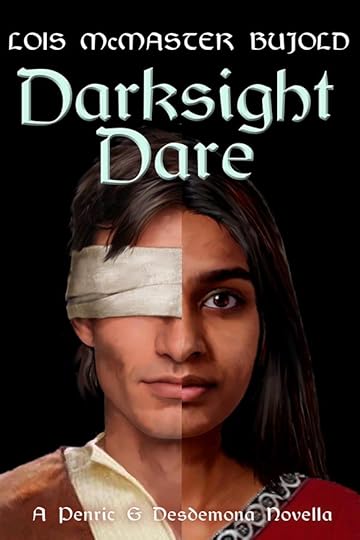
Herewith the latest version, including the upcoming Pen & Des novella "Darkside Dare", expected to be up as an ebook toward the end of April, and the just-available
Two Tales print-on-demand mini-collection, which I'll make another post about soon.
(The novellas get quote marks, the novel titles are left as plain text.)
A Bujold Reading-Order Guide
Note: almost all of my titles are presently widely and instantly available both as ebooks, and as audiobook downloads.
The Fantasy Novels
My fantasy novels are not hard to order. Easiest of all is The Spirit Ring, which is a stand-alone. Next easiest are the four volumes of The Sharing Knife—in order, Beguilement, Legacy, Passage, and Horizon—which I actually numbered, as this is one continuous tale. The novella “Knife Children” is something of a codicil to the tetralogy.
The first three novels in the World of the Five Gods could each be read separately, but The Curse of Chalion and Paladin of Souls are more closely connected, a duology better read in that order. The Hallowed Hunt is more of a stand-alone, taking place in a different realm and earlier century and not sharing characters (apart from the gods) with the others.
In terms of internal world chronology, The Hallowed Hunt would fall first, the Penric novellas perhaps a hundred and fifty years later, and The Curse of Chalion and Paladin of Souls would follow a century or so after that.
The internal chronology of the Penric & Desdemona subseries is presently:
“Penric’s Demon”
“Penric and the Shaman”
“Penric’s Fox”
“Testimony of Mute Things”
“Masquerade in Lodi”
“Penric’s Mission”
“Mira’s Last Dance”
“The Prisoner of Limnos”
“The Orphans of Raspay”
“The Physicians of Vilnoc”
The Assassins of Thasalon
“Knot of Shadows”
“Demon Daughter”
“Penric and the Bandit”
“The Adventure of the Demonic Ox”
“Darksight Dare”
(“Demon”, “Shaman”, and “Fox” are collected as paper volumes in Penric’s Progress; “Mission”, “Mira” and “Limnos” in Penric’s Travels; “Lodi”, “Orphans” and “Physicians” are collected in Penric’s Labors; and Thasalon and “Knot” are collected in Penric’s Intrigues.)
Other Original E-books
The short story collection Proto Zoa contains five very early tales—three (1980s) contemporary fantasy, two science fiction. The novelette “Dreamweaver’s Dilemma” may be of interest to Vorkosigan completists, as it is the first story in which that proto-universe began, mentioning Beta Colony but before Barrayar was even thought of.
Sidelines: Talks and Essays is a collection of three decades of my nonfiction writings, including convention speeches, essays, travelogues, introductions, and some less formal pieces.
The Gerould Family of New Hampshire in the Civil War: Two Diaries and a Memoir is a compilation of historical documents handed down from my mother’s father’s side of the family. A meeting of time, technology, and skillset has finally allowed me to put them in sharable form.
The Vorkosigan Stories
The debate around the ‘best’ order in which to read the Vorkosigan saga mainly revolves around publication order versus internal-chronological order. I favor internal chronological, with a few adjustments.
It was always my intention to write each book as a stand-alone, so that the reader could theoretically jump in anywhere. But as the series developed it acquired a number of sub-arcs, closely related tales that were richer for each other. I will list the sub-arcs, and then the books, and then the duplication warnings. And then the publication order, for those who want it.
Shards of Honor and Barrayar. The first two books in the series proper, they detail the adventures of Cordelia Naismith of Beta Colony and Aral Vorkosigan of Barrayar. Shards was my very first novel ever; Barrayar was actually my eighth, but continues the tale the next day after the end of Shards. For readers who want to be sure of beginning at the beginning, or who are very spoiler-sensitive, start with these two.
The Warrior’s Apprentice and The Vor Game. The Warrior’s Apprentice introduces the character who became the series’ linchpin, Miles Vorkosigan; the first book tells how he created a space mercenary fleet by accident; the second how he fixed his mistakes from the first round. Space opera and military-esque adventure, The Warrior’s Apprentice makes another good place to jump into the series for readers who prefer a young male protagonist.
Borders of Infinity (3-novella collection) should be read before Brothers in Arms. Containing three of the six currently extant novellas, it makes a good Miles Vorkosigan early-adventure sampler platter for readers who don’t want to commit themselves to length, but it will make more sense if read after The Warrior’s Apprentice. Its three stories are short, not slight, and introduce some elements that are revisited later in the series.
(These novellas are also available ala carte by title as ebooks, as listed below so readers can see where they fit distributed in the timeline, but the collection is the preferable format. Even its little frame story has a few payoffs later on.)
After that: Brothers in Arms should be read before Mirror Dance, and both, ideally, before Memory.
Komarr makes another alternate entry point for the series, picking up Miles’s second career at its start. It should be read before A Civil Campaign.
Falling Free takes place 200 years earlier in the timeline and does not share settings or characters with the main body of the series. Most readers recommend picking up this story later. It should likely be read before Diplomatic Immunity, however, which revisits the “quaddies”, a bioengineered race of free-fall dwellers, in Miles’s time.
The novels in the internal-chronological/recommended reading order list below appear in italics; the novellas (officially defined as a story between 17,500 words and 40,000 words) in quote marks.
Shards of Honor
Barrayar
The Warrior’s Apprentice
“The Mountains of Mourning”
“Weatherman”
The Vor Game
Cetaganda
Ethan of Athos
Borders of Infinity (3-novella collection)
“Labyrinth”
“The Borders of Infinity”
Brothers in Arms
Mirror Dance
Memory
Komarr
A Civil Campaign
“Winterfair Gifts”
Falling Free
Diplomatic Immunity
Captain Vorpatril’s Alliance
“The Flowers of Vashnoi”
CryoBurn
Gentleman Jole and the Red Queen
Advisories:
The novella “Weatherman” is an out-take from the beginning of the novel The Vor Game. If you already have The Vor Game, you likely don’t need this.
The original ‘novel’ Borders of Infinity was a fix-up collection containing the three novellas “The Mountains of Mourning”, “Labyrinth”, and “The Borders of Infinity”, together with a frame to tie the pieces together. Again, beware duplication. The frame story does not stand alone.
“Winterfair Gifts” and “The Flowers of Vashnoi” have been collected in the Ingram Spark indie paper-only volume Two Tales, ISBN 979-8-218-73016-1. They are also available individually as ebooks and audiobooks along with the rest of the series.
Publication order:
This is also the order in which the works were written, apart from a couple of the novellas, but is not identical to the internal-chronological. It goes:
Shards of Honor (June 1986)
The Warrior’s Apprentice (August 1986)
Ethan of Athos (December 1986)
Falling Free (April 1988)
Brothers in Arms (January 1989)
Borders of Infinity (October 1989)
The Vor Game (September 1990)
Barrayar (October 1991)
Mirror Dance (March 1994)
Cetaganda (January 1996)
Memory (October 1996)
Komarr (June 1998)
A Civil Campaign (September 1999).
Diplomatic Immunity (May 2002)
“Winterfair Gifts” (February 2004)
CryoBurn (November 2010)
Captain Vorpatril’s Alliance (November 2012)
Gentleman Jole and the Red Queen (February 2016)
“The Flowers of Vashnoi” (May 2018)
Happy reading!
— Lois McMaster Bujold
posted by Lois McMaster Bujold
on April, 06
https://www.goodreads.com/author_blog_posts/26506568-bujold-reading-order-guide-spring-2026-update
![[personal profile]](https://www.dreamwidth.org/img/silk/identity/user.png) aurumcalendula
aurumcalendula
![[community profile]](https://www.dreamwidth.org/img/silk/identity/community.png)

![[syndicated profile]](https://www.dreamwidth.org/img/silk/identity/feed.png)